Getting around Mauritius comes down to five main transport options for tourists: hire cars, NLTA-licensed taxis, Uber, the public bus network, and the Metro Express light rail. The best option, though, depends entirely on itinerary type. For a resort-based tourist taking a small number of organised day trips, taxis work well. However, an independent traveller planning multi-region exploration will find a hire car the most practical option for covering all six regions. In addition, Mauritius drives on the left. Distances are also short, since the island is approximately 65km north to south and 45km east to west.
Key Takeaways for Getting Around Mauritius
- Hire cars are the most flexible transport option for independent tourists. Small cars cost around MUR 1,200 to 2,000 per day and give full access to all six regions.
- The National Land Transport Authority (NLTA) licenses taxis in Mauritius. Full-day hire for four to five destinations typically costs MUR 2,500 to 4,500. So agree the fare with the driver before setting off.
- Uber has operated in Mauritius since 25 March 2026 as “Taxi by Ala-lila, powered by Uber”. It books licensed local taxis through the Uber app, with fares set in line with the prices taxis already charge.
- Public buses serve most major towns and tourist areas, with fares that depend on distance (typically MUR 17 to 47 per journey). However, they do not run to strict published schedules in all areas and do not reach all tourist sites directly.
- The Metro Express light rail runs between Port Louis and Curepipe via Rose Hill. It has zone-based fares, but it only serves the central corridor.
- Mauritius drives on the left. Posted speed limits drop when you enter towns and villages. The drink-driving limit of 20 mg of alcohol per 100 ml of blood (0.2 g/L) is strictly enforced.
What Are All the Transport Options for Getting Around Mauritius?
The five transport modes available to tourists in Mauritius cover a wide range of cost and flexibility. Hire cars (MUR 1,200 to 2,000 per day) give the most flexibility. They are also the most practical option for reaching all six regions, including inland and southern coastal routes. NLTA-licensed taxis (MUR 300 to 800 for short trips, MUR 2,500 to 4,500 for full-day hire) are ideal for airport transfers and evening travel. Uber books licensed local taxis through its app. Public buses (typically MUR 17 to 47 per journey) are the lowest-cost option and serve most major towns. The Metro Express light rail runs between Port Louis and Curepipe via Rose Hill, with zone-based fares. Prices shown are indicative and vary by season, operator and negotiation, so confirm the cost when you book.
For arrival logistics, the journey from Sir Seewoosagur Ramgoolam International Airport to Port Louis is approximately 40 to 60 minutes by car (about 48 km). Journey times to resort areas vary by destination and traffic. Therefore, a pre-arranged hotel transfer or NLTA-licensed taxi is a practical first transport choice.
Is Hiring a Car the Best Way of Getting Around Mauritius?
For independent tourists who want to cover multiple regions, a hire car is the best transport option in Mauritius. The island’s comprehensive road network, left-hand driving (familiar for UK tourists), and short distances between regions make self-drive practical. It is also cost-effective over a week or longer. For example, at the indicative prices above, a hire car used for four to five days of a seven-night trip costs less in total than the equivalent in daily taxi hire.
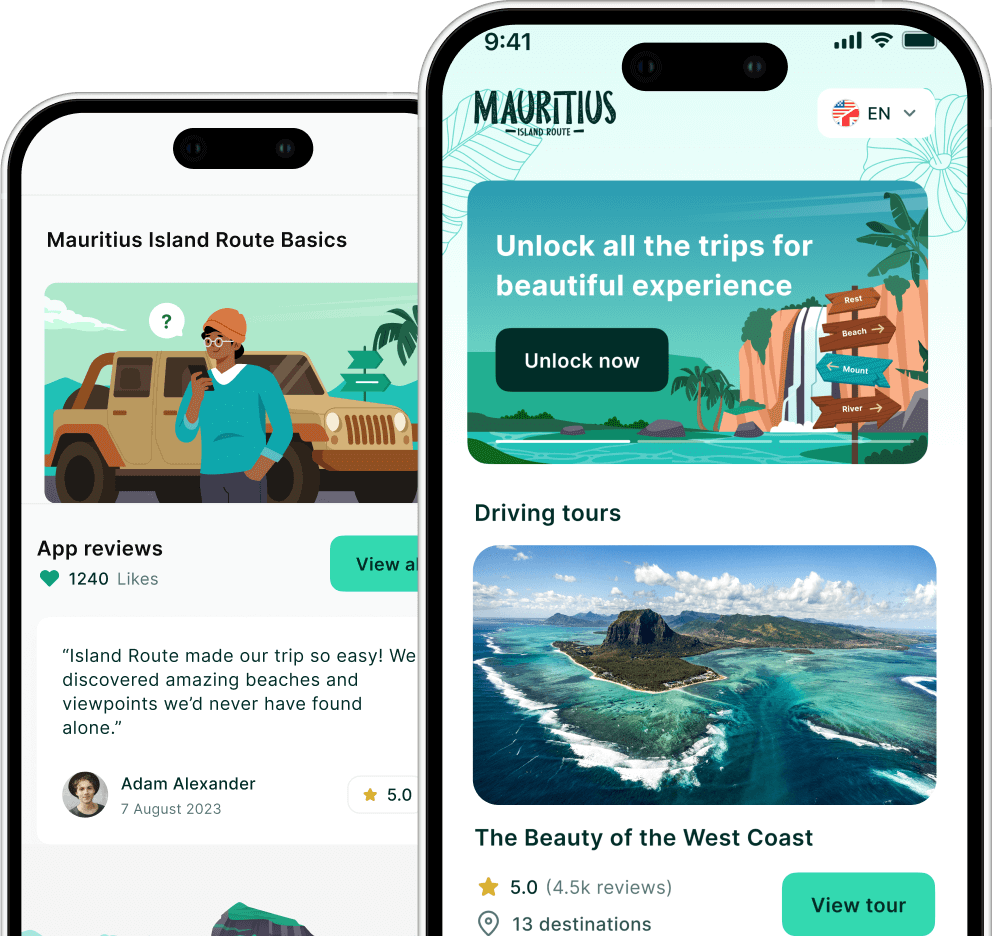
The main requirements are a valid driving licence and a reliable navigation solution. Hire car companies often set stricter requirements, such as a year of driving experience, a higher minimum age and an International Driving Permit (IDP), so check the terms with your rental operator before booking. The Island Route app provides hands-free, GPS-triggered audio guidance for Mauritius self-drive routes. It plays narration and essential driving directions automatically as you drive, and the tour audio works offline once it is downloaded. Google Maps, if you use it for navigation, still needs an internet connection. For budget and timing tips, see the Island Route guide to travelling smartly around Mauritius, which covers affordable transport options and digital planning tools.
How Do Taxis and Uber Work in Mauritius?
Taxis in Mauritius operate under a Public Service Vehicle (PSV) taxi licence issued by the National Land Transport Authority (NLTA). Agree the fare with the driver before the journey begins.
Uber has operated in Mauritius since 25 March 2026 as “Taxi by Ala-lila, powered by Uber”. The service books licensed local taxi drivers through the Uber app, and its fares were set to stay in line with the prices taxis already charge. Check the app for availability in your area. Arriving tourists planning a first transfer can choose a pre-booked hotel transfer or an NLTA-licensed taxi.
Is Public Transport Practical for Tourists in Mauritius?
The National Transport Corporation (NTC) and private operators run the Mauritius public bus network, which covers most major towns and tourist areas. Fares depend on distance (typically MUR 17 to 47 per journey), which makes buses the most affordable transport option on the island. However, buses in Mauritius do not run to strict published schedules in all areas. They can also become crowded and may not serve specific tourist sites directly.
The Metro Express light rail system runs between Port Louis and Curepipe, passing through Rose Hill. Fares are zone-based, and an MECard works out 5 to 10 per cent cheaper than a single-use ticket, so it is an affordable way to cover this central corridor. However, the Metro Express does not currently extend to coastal resort areas. So it supplements rather than replaces road-based transport for most tourist itineraries.
What Are the Practical Tips for Getting Around Mauritius?
For self-drive tourists, the most important practical steps are simple. First, download navigation apps before departure rather than at hotel Wi-Fi on the first evening. After that, obtain a phone car mount for legal hands-free navigation. Then fill up at petrol stations before driving into rural areas near Black River Gorges National Park and the south coast, and keep some cash, because some petrol stations accept cash only. Finally, carry a power bank for device charging on full-day drives.
Some shops and petrol stations accept cash only, so Island Route’s Mauritius travel FAQ recommends having around MUR 2,500 with you. This applies to all tourists, regardless of transport mode. The UK FCDO travel advice for Mauritius also covers road travel, including driving licence requirements, left-hand traffic and driving conditions.
Getting Around Mauritius: Match Your Transport Choice to Your Itinerary
Mauritius does not require a single transport strategy. Most visitors benefit from a combination of approaches: a hire car for multi-region exploration days, Uber or pre-arranged taxis for evening travel, and public buses for simple urban hops. The key decisions come at booking stage. Hire a car if you plan more than three regional day trips, pre-book airport transfers in both directions, and download navigation before departure. Overall, these three steps cover the practical transport preparation for the vast majority of Mauritius itineraries.
Navigate Every Mauritius Route With Island Route – Self-Drive GPS Audio Tours
Download Island Route before your trip for GPS audio-guided self-drive routes across the available Mauritius regions. After tour audio is downloaded, it works without WiFi or mobile data (Google Maps, if you use it for directions, still needs an internet connection). The audio narration includes essential driving directions, practical travel tips and cultural context. This makes every self-drive day more rewarding.